How I Won 15 Upwork Projects in 52 Days (With a New Account)
Campaign performance
Averages across the campaign, on an Upwork account that started with no badges and no history.
The numbers — with receipts
When we recorded this interview on June 23, Ahmed was ~52 days into an essentially brand-new Upwork account: 12 contracts closed across 10 clients, worth around $5,200. No Rising Star badge, no Top Rated, next to no history — the exact profile the "you can't start on Upwork in 2026" crowd says can't win anymore.
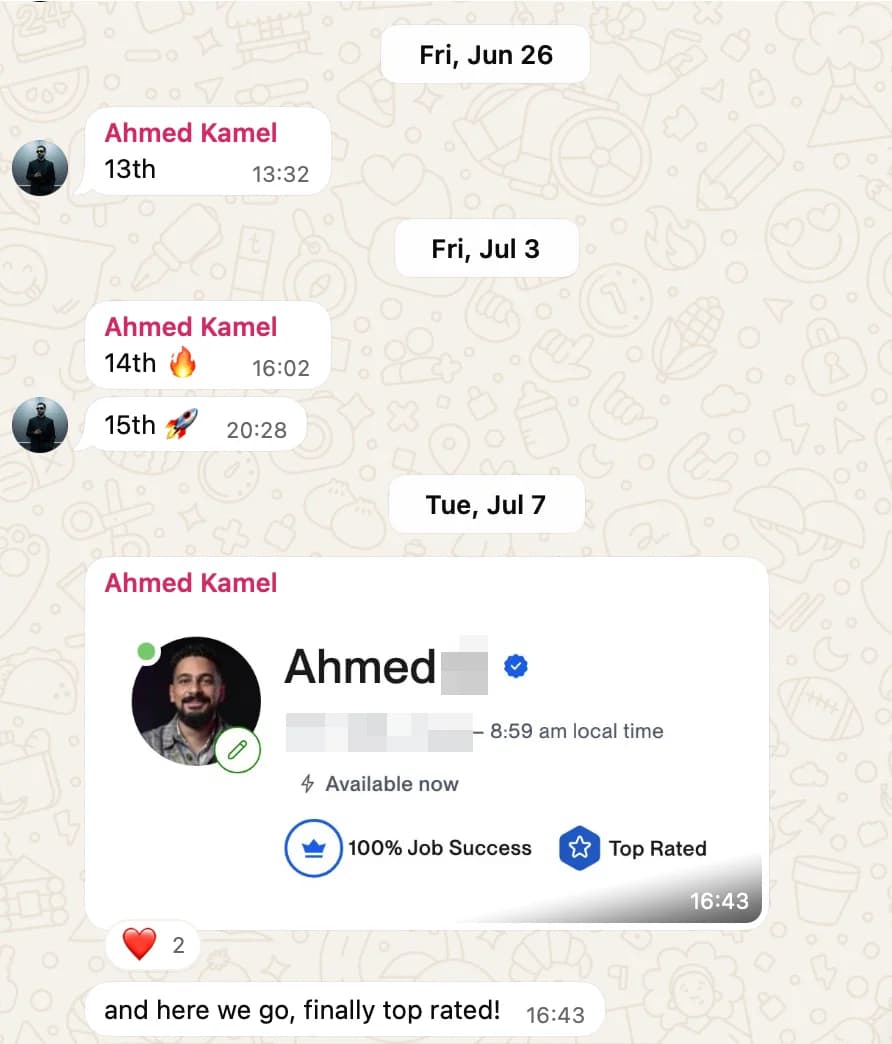
Then, in the days after we stopped recording, the WhatsApp messages started arriving: contract 13 on June 26, contracts 14 and 15 on July 3 — and on July 7, the screenshot: 100% Job Success, Top Rated.
Ahmed's messages after we recorded: contracts 13–15, then Top Rated — all within two weeks of the interview.
The spend behind those 15 projects: the basic $300/month plan, and all-in — subscription plus Upwork connects — Ahmed estimates $1,500–1,600 total. And it compounds: 5–6 of his 10 clients became hourly retainers that bill every single month, and two came back to sign second contracts after their test project.
I'm a new profile, no Rising Star, no Top Rated badges — and I closed 10 clients with 12 contracts in 50 days.
Ahmed Kamel — Founder — Paid Ads Agency
Rewind: $4,000 in, $100 back
Those numbers almost didn't happen — because Ahmed's first run at Upwork nearly convinced him the platform was broken. He wasn't looking for a side hustle: his agency was already doing serious work, but new clients came from pitching, referrals, events. None of it predictable. He wanted a channel he could turn on every month, and Upwork was the obvious candidate. Applying to jobs 24/7 isn't realistic when you're running an agency, though — so in mid-2025 he went looking for AI automation to do it for him.
He picked one of the tools on the market. What he got was a product built by a team that — in his words — didn't understand the mechanics of converting on Upwork. Their profile advice peaked at "instead of saying paid ads, say Meta ads." Which keywords matter? Should he add a video? Consultations, catalog projects? "It should be good" was the level of answer he got back. And when something underperformed, they couldn't tell him what was broken, let alone how to fix it.
The result: around $4,000 spent, a ton of proposals sent — and one single $50 job. That client picked him for one reason: he was the only applicant whose English the client could actually understand. Ahmed did three days of work on it to earn his first five-star review, and the client tipped him an extra $50 for the effort.
I spent $4,000 and got $100 back. The worst ROI investment I ever made.
Ahmed Kamel — Founder — Paid Ads Agency
Doctors, not general practitioners
Here's the part most people get wrong: Ahmed didn't conclude "Upwork doesn't work." He concluded he was doing it wrong. Other freelancers were clearly winning on the platform, so the opportunity was real — the setup was the problem. That's the paid-ads operator mindset: when a campaign flops, you don't blame the ad platform. You fix the campaign.
You guys are the doctors of the whole thing — the others were general practitioners.
Ahmed Kamel — Founder — Paid Ads Agency
When Ahmed came to us, we didn't start with automation. We started with diagnosis. Before he ran a single campaign, three things changed:
- Profile first. We sent him to the Upwork coach we work with, and he rebuilt his profile from scratch. His $65M track record was technically on his old profile — it just didn't communicate it, so it read like the numbers might be fake. Now the profile leads with it.
- Campaigns through his own account. Lancer runs the automation directly through your Upwork account — not through third-party manager accounts like the competitor did. Proposals go out as Ahmed, with his portfolio projects attached so clients see real work and real results.
- Numbers that mean something. From the very first calls we looked at his reply rate and conversion percentages and told him exactly what was off and what to fix — the difference between a tool and a system.
The optimized profile started doing its own work, too. Ahmed began getting invitations to jobs he never applied for — his profile now surfaces for the right searches and communicates value to exactly the caliber of client he's after.
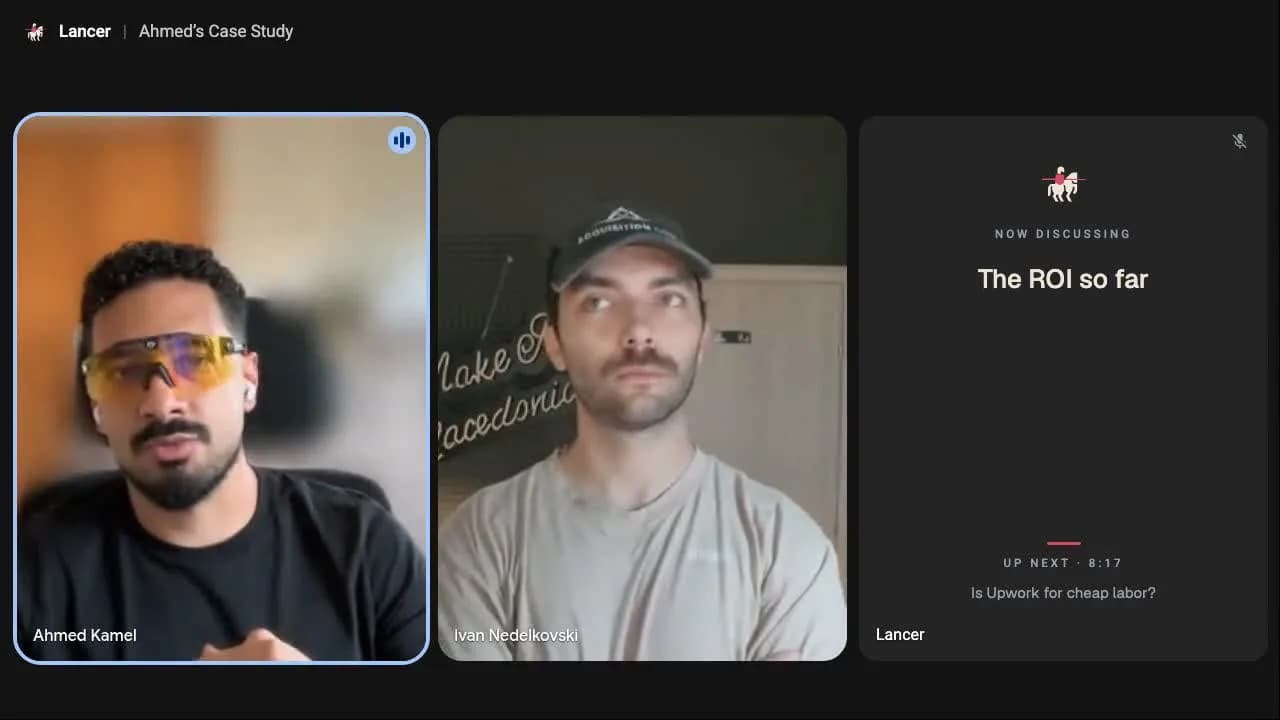
From the interview: breaking down the ROI so far — watch the full conversation above.
"Upwork is for cheap labor"
Back in his competitor days, a client sent Ahmed a contract, then canceled it with a message: why are you here? You charge a lot. Upwork is for cheap labor — you shouldn't be here. The punchline: that client was charging a similar rate for his own services.
Ahmed's run since then says the cheap-labor story is a targeting problem, not a platform problem. His first contract after optimizing was $10/hour. Then $25, $40, $50 — and today he closes clients at $65/hour who are, in his words, happy to pay it. Bargain hunters look for profiles that started yesterday. Clients who are serious about their business look for proof you'll return multiples of what they pay — and Ahmed's profile now leads with exactly that proof.
It's not that Upwork is for cheap labor. You need to do the right things to attract the right set of eyes.
Ahmed Kamel — Founder — Paid Ads Agency
Repeatable, scalable, predictable
Ahmed's takeaway from the whole run isn't "Upwork is great." It's sharper than that: you cannot judge something you didn't try correctly. His first attempt was never a real test of Upwork — it was a test of a bad setup.
His advice for anyone building income streams borrows from Sabri Suby's "Sell Like Crazy": a channel is only worth building if it's repeatable, scalable, and predictable. Upwork — done right — checks all three. Repeatable: campaigns run every single month. Predictable: you know your reply rate, your cost per lead, your cost per contract, so you can forecast what a month buys you. Scalable: spend more connects, add services, add people — while retainer clients from previous months keep stacking on top.
That's exactly the thesis Lancer is built on: Upwork isn't a job board, it's a paid-acquisition channel. Ahmed hasn't touched his initial campaign setup since we made it — it just runs, and he closes the replies. An automated funnel for leads, on a platform where the clients are already looking for you.
Make sure what you're building is repeatable, scalable, predictable. That's what you can do with Lancer on Upwork.
Ahmed Kamel — Founder — Paid Ads Agency
Full transcript — Lancer Case Study Ep. 1: Ahmed
Auto-transcribed and lightly edited. Download it to feed into Claude Code or any other AI agent.
Show full transcriptHide full transcript
Full conversation
Okay, so guys, this will be probably like a series of case studies we're doing and to highlight the performance of one of our top users, where that's gonna be weekly, by weekly month, I'm not sure, but Ahmed is one of our top performers and it's very, what's very unique about him is he's kind of defined the, I would say the narrative that you can't really start on app work in 2025 or 2026, it's too late. Only established freelancers or agencies are getting deals on app work.
And he started with us with essentially a brand new account and he closed, I think, what's the tagline? Like, 20 projects in like 50 days, something about Ahmed? Almost yeah, 12 projects within like 52 days. Yeah, so I would love for you to share your story on how basically with the fresh account, with basically our help as well, you went from zero to 12 projects in like 50 days and your experience with top work, with cancer and yeah, go ahead, take the stage. So basically in the beginning, I was like, okay, I have a business and they need to like, cramp this up in terms of the income streams and that I've knew the business is doing.
So I was looking for more income streams rather than pitching clients or going to events or anything of that sort. So I started to begin to what would be the best way to get extra clients and one of them was up work. And because it's very hectic to be like applying 24, seven, which again, you also can't apply for jobs 24, seven. I started to find or like to research about some AI automations, maybe services that even thought of like building this would like, whatever AI was there, back in like I think mid 2025.
And what happened after that is I started with one of the services in the market, which was so bad because they didn't have the knowledge and the experience of how to convert on up work. So what they did was they built the product but they don't understand the mechanics. So if something is broken, they cannot tell you, okay, here is the issue or that is the problem or you need to fix this or you need to work on that. No, their knowledge was quite basic, which is yeah, instead of saying that you were unpaid ads, you need to say meta ads.
Yeah, but what other keywords, what other descriptions should I be there? Do I need to put a video? Do I not need to put a video? Do I need to have some consultations and catalogs and all of that? They were just like, yeah, it should be, but how can be done? They don't know this. So they're not sure it's quite basic. And through my experience, I think I lost around $4,000 while I applied for a ton of jobs. And what I got was one single job with $50.
And the guy basically worked with me for one single reason because he said that I know how to speak English. The rest of the people that were applying, they had shitty English, it was so bad. He couldn't even communicate to them. He couldn't understand them. So the moment he found someone who can communicate and he could just understand, he was like, okay, we need to work together. So for me to get the first client closed, I did a job for $50, almost for like three days of work, just to have one job, one five star testimonial on the platform.
And after we finished this, he even gave me like $50 extra on top of it just because like we thought about the work. So I would say that this has been the worst return on an investment I ever like did in my entire life. Wait $4,000, I go to $100 back. And this made me feel like there's something wrong. So I was searching for more until I met you guys, which you guys are doctors of the whole thing like literally. You guys are experts in what you're doing.
The other guys were like general practitioners while you guys were the specialized team who know how to do it, why to do it, how it should look like and what final output we might expect with and how much time. So since they won, I came to you, we had to talk to me in your event and it was like, okay, like I just gave you the whole thing, hey man, this happened. I'm here to experience your product or service. And let's just take it from there.
And I followed everything you guys said, wishes. Let's number one, go to the Upwork coach that you guys work with to help me optimize everything. I did everything as he mentioned exactly and then we set up the profile with the campaigns that we have on Lancer. And then after that, yeah, like 52 days, 12 contracts closed, some of them are like already clients working with us like for like, already like last almost two months. Some of them came here for like one time gig and that's it.
But also give you some context. These 12 contracts so far may like 5.2 or 5.3 thousand dollars, which is also great. Yeah, we are not spending much on Lancer. I even have the basic package. If I remember correctly, I have the $300 a month or something. Plus per month, I think I'm spending maybe $300 for $100 more. So if you just do the math the first time I paid Lancer, I paid the three months in advance. I think I paid like 600 something dollars. Plus so far, let's say worst case scenario, I paid a thousand dollar on just Upwork Connect.
So I paid like let's say 1.5 thousand or 1.6 thousand. Maybe $3,000 back. And yeah, less than this. Sorry, within the first 50 days. Yeah, within the first 50 days. Currently I also have let me tell you one, two, three, four, five. I have five or six clients out of 10 clients. I have five or six out of 10 clients. They are clients that are like working on like hourly basis. So these folks have every single month. They are still bidding the four other clients. They were one time gigs and two of the 10 clients I closed, they did two other contracts.
So they came, let's say for a test project. They liked what they got to service and the fast communication, transparency, professionalism and like everything. So they started to work on longer contracts. Also one more thing to finalize or just answer your question that I've got that Upwork is for cheap labor, which is basically one of the most true comments I ever received from a client. And it was again with that previous tool I worked with. The guy told me, why are you here? You actually charge a lot.
Upwork is for cheap labor. You shall not be here. He exactly told it to me like this. And he sent me a contract. I thought he wants to work together and then he canceled it and then he sent me that message. So he was actually charging my rate, which is so weird. Currently, I have some clients who want charge at $65 an hour and they're so happy to pay it. They were paying this and they came against to pay it. $40, $50 and yeah, it's so for cheap labor.
It's just you need to do the right things to attract the right set of eyes, that's it. Cool, awesome. And do you have any like, you mentioned a couple of things but you have like some high level things of like what was the, what are you doing differently now? As opposed to be dollar tool, I would say. What I'm doing differently now is the card set up of how the upwork profile looks like. Previously, my upwork profile was not optimized. So when you go to my upwork profile, that looks like a random guy will just start to the yesterday.
And this is what I mean by you guys know what you're doing and they were just degenerate practitioners. For anything, they were just gave you the paint killer but you guys know where to look for the problem and how to fix it. So after optimizing the platform, the first contract I got was for $10. And yeah, like it was just $10 an hour. The rest of the contracts I'm getting are $40, $25, $50, $65. So the way you're optimizing the way your profile looks like and how optimized it is, it attracts the caliber you're looking for.
The people who want the cheap labor, they are mostly looking for someone who just started yesterday, like literally started yesterday. They want to hunt the lowest out of the age so they can make the most revenues. But clients who are serious about their money and what they are doing and their businesses, they don't care how much they pay you because they know that you'll make them multiple returns for that money that they're spending with you. So I would say the first thing would be my profile is more optimized and is more straight to the point.
Also, I started to get invitations on random jobs that I didn't apply for. So how did I appear to these guys as well? So because my profile is also optimized, I appear to a certain caliber of people based on the keywords they search for. And the second thing I get selected because my profile actually communicates my value. So even though yes, I and my team, we made more than $65 million in a revenue for the clients we worked with. The previous profile before working with you guys, yes, it had this, but it didn't communicate it.
So it looked like maybe we are faking the numbers. But after we optimized everything, everything looked let's say more professional, more niche, more like luxurious for actually someone who made that amount of money for their clients, but someone actually starting. And this started to attract people who come say, hey, we saw your profile, we like it, we want to work with you. And for sure, that's a completely different story. One more thing I would also say that your product is attaching the, like, what is it called?
The projects that I have on the profile, which also gives them to see what type of work did we do? How are the results we brought to the clients and all of that? Yeah, that's the way we, that's kind of different, that's based on a different approach when it comes to automation. And I think the two that used previously doesn't really run the automation through the user's account, but it goes through like a third party agents, manager accounts, etc. So it's not really fully automated through the account.
I would love to know your basically take away after essentially now, like if we were a couple of months back with a different tool, and now it has a couple of months, and you're still relatively new and upward. What's your basically take away on the platform itself? So basically, because you know, a lot of people were discussing before we started recording, a lot of people, especially on radio, don't link, you will say, oh, Upwork is dead, you know, like stay away from it, like you just burn money.
You as a new user starting in 2026, like what has been your take away of the platform? My take away is you cannot judge something you didn't try correctly. When I tried Upwork before, I tried it without optimizations. The team I was working with, or the tool I was working with, they said that they understand it, but they didn't. Also, when I needed support, yeah, they scheduled the calls with me, but they don't know what to do. But when I came to you guys, everything was so different for me.
And it was so different and it was so obvious from day one that even when I shared with you the numbers, in the very initial calls of my, like, let's say, reply rate and all these percentages of conversion, what you were mentioned was like, oh, no, this is bad. This means that there is something wrong. So before even working on Lancer, or before having the setup on Lancer, what you recommended was to go to the Upwork coach, start to work with them and then come back to Lancer.
They didn't even recommend something like this. So my biggest takeaway is make sure you put all the positive pieces together when you're trying something new because Upwork is not that there is so much money that can be done there. And again, I am not even like doing the crazy work there. I am a new profile. I have, I don't know, like, less than 10k, I don't have the rising star badge or the top rated plus or whatever, like the no rising star, not upgraded, not upgraded plus badges.
And I closed 10 climbs with 12 contracts in 50 days, more than 5.2 thousand dollars, 5,200 dollars so far. So imagine if I have the rising star badges or the top rated plus, there's again, there's so much can really happen there. Yeah, yeah. And again, like I feel like you're killing it and that's why I wanted to have it here in Brazil. I think your approach is a differentiator. And I think when it comes to Upwork a lot of these, people are differentiated by the mindset, the mindset they're coming in and the approach they have on the platform.
If people like you come in with all look, wait, I can dissect all this weight. There's a ton of opportunity here, but I need to do these things to basically make it work. And I need to make a replacement. What you did and what's very rare is basically you actually burned $4,000 in figuring it out as a channel. And you didn't get an ROI and you still didn't give up. You're like, you know what? Actually, there still might be value here. I see this guy, I see that guy.
You know, I open up and you do this guy's killing it. And maybe I'm doing something wrong. So you gave Upwork a second chance with a different approach to Lancer. And basically you made it work, right? And I think maybe this, thanks to your experience with running, you know, pay that campaigns where you know there's a lot of experimentation and make it work. And you know, that's what actually Lancer is. Like that's how I've always been pitching it really on. It's kind of transitions upwork from like this broke and a messy place to make actually a paid acquisition channel.
Like once you set it up, I don't think you even have actually touched the initial setup that we made on Lancer, right? Maybe it's something that's not at all. So basically you just start it up running and then you have like basically, you know, you have the conversion rates, you know, how many people have opened your proposals, how many reply rate, what's your cost per reply. And you know, and basically what you've done is basically like automated funnel for getting leads and then you closing it because you're very good at this and what you do.
And again, as you mentioned, this was scale and scale scale. Awesome. So I guess I think we covered what I wanted to cover. I will have to do this short. Maybe I'll give you the floor if you have anything else to add for like people that are considering this or thinking or they're like on the edge of whether they want to jump, make the jump toward just initially the upwork itself, not with our tour or anything. And what would you basically give them as an advice whether they should do it and if they do it, how to do it so they don't burn like $4,000, maybe as you did, like, you know, I would say that for businesses in general, when they are building their income streams, they need to make sure that they don't put all the eggs in one basket.
And for the business to be safe, but they need to diversify their income streams. The problem that a lot of business owners fall for is that sometimes they are building or they're focusing their efforts on revenue streams or income streams for their business that are not repeatable or scalable or predictable. I was reading this book called, said like crazy for a guy called Sabri Zubi and what he said that when you're building and like an income stream or revenue stream, it needs to have three elements which are it needs to be repeatable, scalable and predictable.
These three elements exist on a channel like upwork. You can do this every single month, it is repeatable, it is predictable based on the data that you have, you know, how much on average you can close, your average costs, cost per lead, cost per like applying, cost per like final contract. And it is scalable because yes, you can spend so much more on it in terms of connects. You can increase your like services or like you can absent people. And not just this, if you get a client in month one and they're working with you to month two and then month two you get another client, you are now working with two clients.
Then one three, you have two from the previous month and then the third month you have it. So my only recommendation to people actually think about this, make sure you do everything right, make sure what you're building is predictable, scalable and just like two, like it's something that can be like repeatable as well. And this is something you can do on upwork and this is something you can do with the answer on upwork. So this also de-risks your business when I cliently is that you have, yeah, now we have a problem, what shall we do, we need to replace it, no.
Now we are not thinking about this because upwork is taking care of it. So yes, it needs the work, but make sure you do the work, right? Awesome, I couldn't have said better myself. I think that's it. Thank you for basically sharing all of this with us and good luck crushing it and scaling on upwork. Absolutely, together, thank you. Thank you.
Good luck crushing it and scaling on Upwork, Ahmed ❤️
Ready to run Upwork like Ahmed does?
Book a demo and we'll show you how Lancer turns Upwork into a repeatable, scalable, predictable client channel — through your own account.