How I Make $30K a Month by Spending $400 on Upwork
Campaign performance
Boosted proposals, sent through his own Upwork account with his profile and portfolio attached.
Seven deals a month, on repeat
Nikola closes an average of 7 deals a month on Upwork by boosting every proposal he sends and sending them systematically instead of only between projects. Lancer finds and qualifies the jobs, drafts the proposals and sends them through Nikola’s own Upwork account, which keeps his profile, reviews and portfolio attached to every application. Since he switched to that approach in April 2025, those 7 deals a month have been worth $30,000–$35,000 in monthly contract value.
We closed three high quality deals in under two weeks, had to pause the campaign because we couldn’t take on more work.
It’s the best problem I’ve had in years.
It’s a great addition to anyone who’s using Upwork for lead gen in any capacity.
The accidental designer
Nikola is a Webflow expert and co-founder of the web design agency Flowscape, based in Skopje, North Macedonia. His Upwork headline reads "#1 B2B Web Designer & Webflow Expert | SaaS & AI | 100+ Sites", he bills $54.50 an hour, and he carries the Top Rated Plus badge with a 100% Job Success Score.
None of that was the plan. Nikola became a designer by accident. In high school he and the friend who is now his co-founder threw student parties, which meant making flyers, which meant opening Photoshop for the first time. Then he worked as a barista, the café needed a logo and asked whether he knew anyone cheap — he volunteered himself. They still use that logo. Webflow arrived the same way a few years later: a client asked for it, he said he would learn on the job at a lower rate, and that was that.
$15, and two weeks of work
His first Upwork job paid $15 — a flat-rate project he worked on for two weeks in December 2019. He was so excited about earning his first money online that he went to bed early on New Year’s Eve to start work in the morning, and kept working through his birthday on 3 January. His second client paid around $40. Then came an hourly contract worth roughly $70. That is the part of the profile most people never scroll down far enough to see.
I was positioning myself almost as an expert even though I was not an expert. My pitch was: I am an expert trying to build out a portfolio on Upwork, so I will do it for a cheaper rate.
Nikola — Webflow Expert — Co-founder, Flowscape
Dropping out
Nikola dropped out of college once Upwork was reliably paying him around $1,000 a month — almost double what he calculated his salary would be as a graduate in North Macedonia. He was 20 and still a student, making $400–$500 a month on the side entirely from Upwork. He was not passionate about what he was studying, the maths had stopped being close, so he left and put the time into building skills rather than chasing rates.
The plateau: bidding only between projects
Six years in, the profile was excellent and the acquisition was not. Delivery filled the calendar, so proposals stopped; when a project ended, proposals started again. For roughly a year and a half Nikola did not apply to a single Upwork job. The work kept coming — his biggest contract on the platform is a $114,699 UI/UX web design engagement for a tech startup, 2,274 hours at five stars — but it arrived in waves he could not forecast or turn up. Meanwhile his other channels were slower: on LinkedIn he once spent seven months chasing a single client before she replied.
April 2025: proposals become a system
In April 2025, Nikola set up a Lancer campaign: Lancer watches the Upwork job feed, qualifies the jobs that match his ICP, writes the proposal and sends it as a boosted proposal from his own account. No third-party manager account, no separate profile — the same Top Rated Plus profile and the same portfolio, just applied consistently instead of in bursts.
He beta tested it for us, so the first messages arrived on Discord the day he flipped the campaign live.
Translated and recreated from Macedonianlink to original

Hey, I set the campaign live 😄
Just so you know — while the manual testing was still running and the automations were still being built, I copied one of the proposals and sent it myself. Today I just landed them as a client 🚀
…and then again, ten hours later.
Translated and recreated from Macedonianlink to original
We could set up a #wins channel — Lancer is killing it
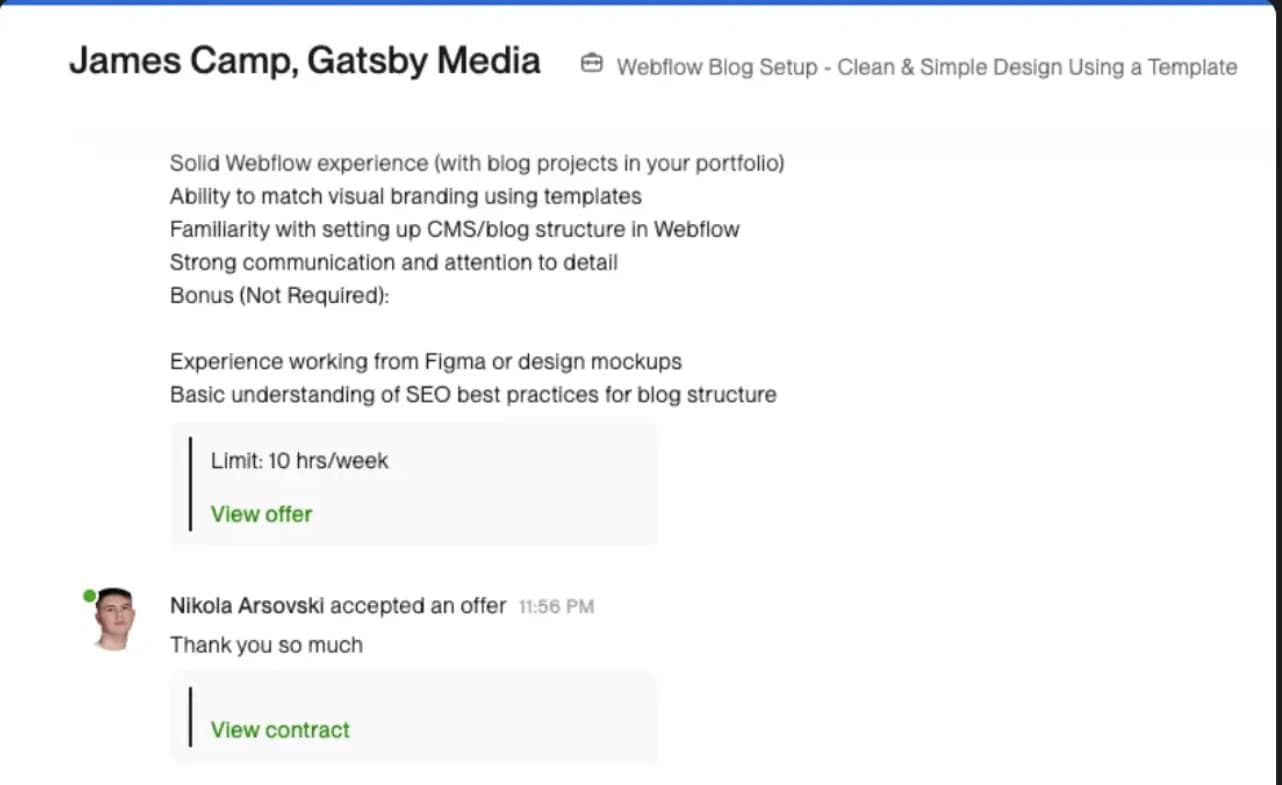

Is this the second one or the first??
Second one today
Week one
One week in, Nikola’s Upwork "My stats" page showed 18 proposals sent, 12 of them viewed, 4 interviews and 2 hires — on a 100% Job Success Score.
Translated and recreated from Macedonianlink to original
Do you boost for first place or fourth?
Well, it depends on the job — but most often yes, first place.
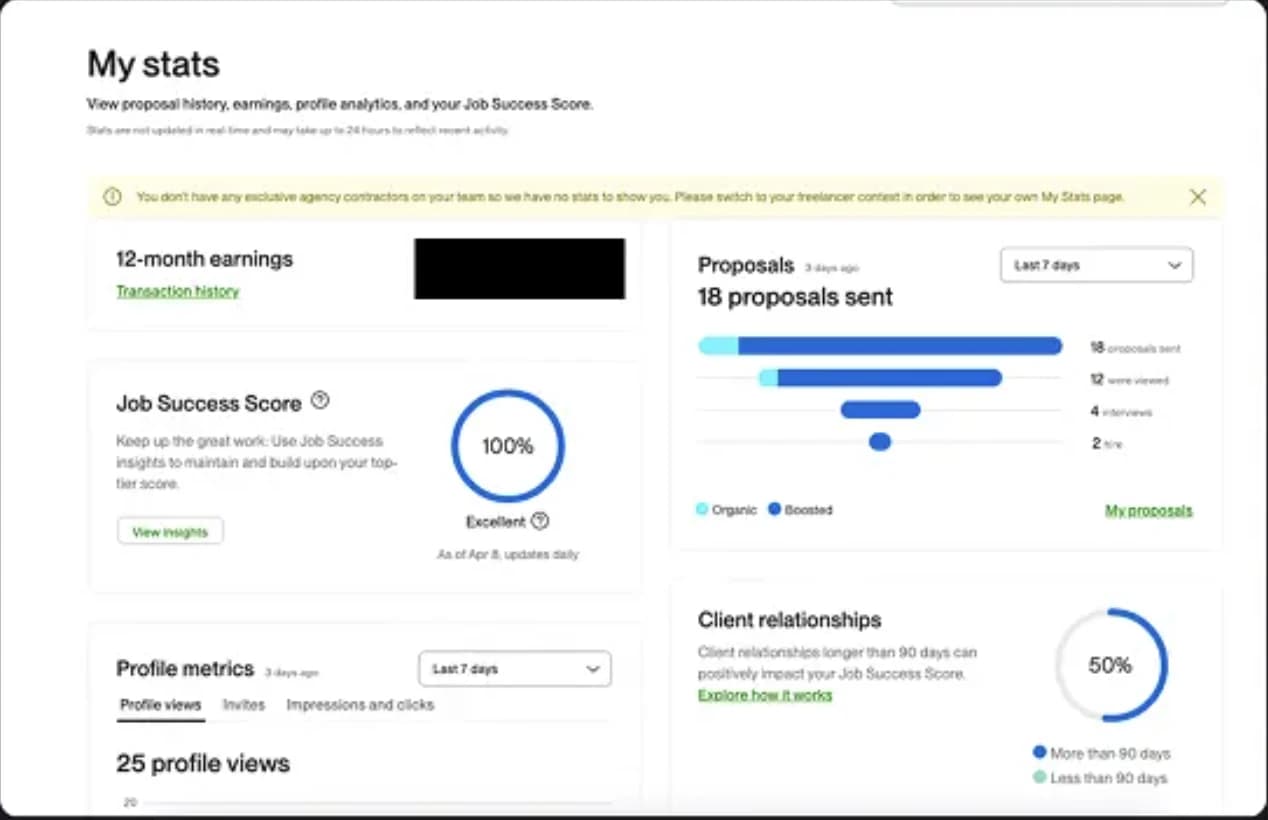
A 97X return on Connects spent in week one is a small sample, and we said so at the time. It held. Nikola settled into roughly 5 replies and 2 new clients a week off about 20 proposals, and by month three he was still sending the same weekly screenshots.
$405 in, $25,000 out
In July, Nikola spent $405 on Upwork Connects, all of it on boosted proposals. That month he won 5 new clients worth $25,000 in total signed deal value, of which $6,603 was paid out to him inside the same month. Against the total deal value that is a 62X return on his Connects spend, and his average client lifetime value is about $5,000.
Winning a $90M Series A client
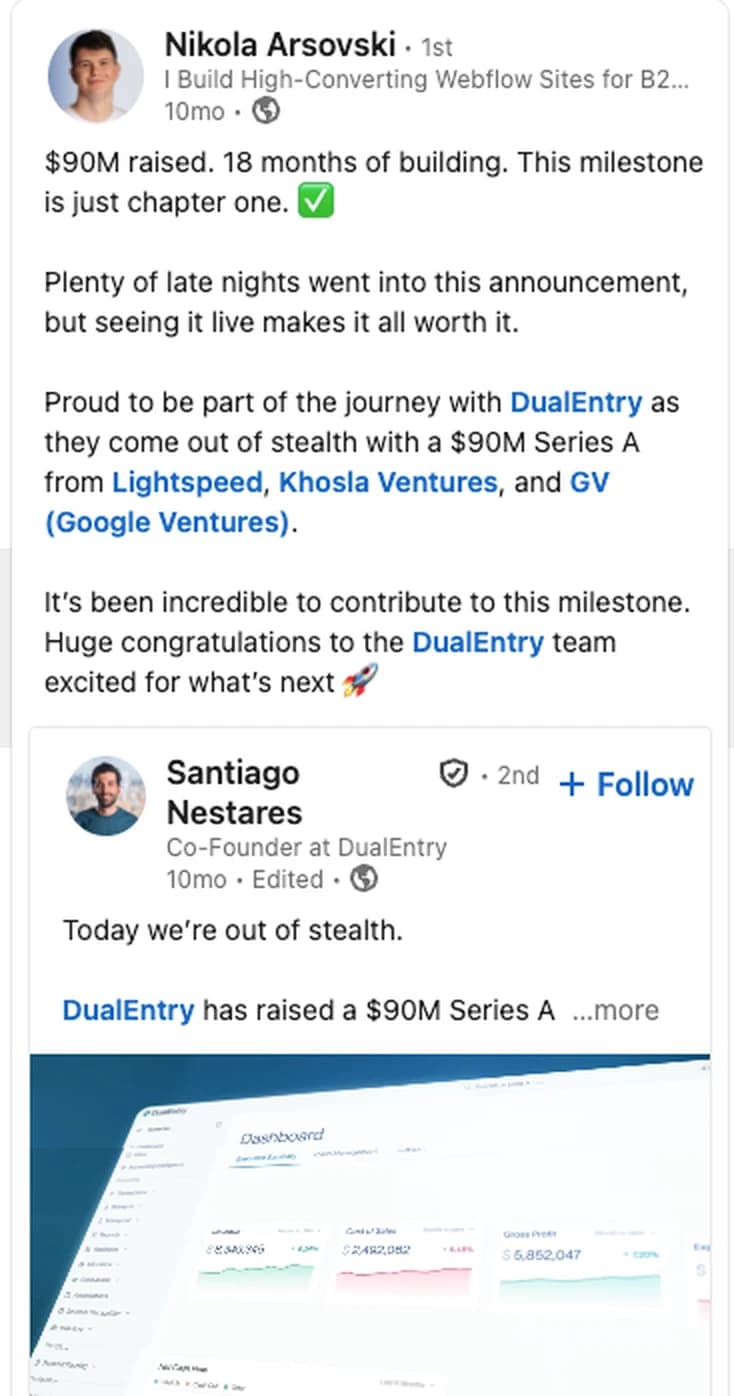
The cost per deal is only half the story — the other half is who the deals are with. In August 2025, Lancer landed Nikola a contract titled "Webflow Developer for AI Accounting SaaS". The client was DualEntry, an AI-native ERP startup that was still in stealth at the time.
On 2 October 2025, DualEntry came out of stealth with a $90 million Series A co-led by Lightspeed Venture Partners and Khosla Ventures, with GV (Google Ventures) participating. Nikola was building their website while that round was being closed. He sent us the news the day it broke.
Translated and recreated from Macedonianlink to original
Btw — the kind of client you can land with Lancer 😄
No way!
Seriously?
Upwork race to the bottom, huh?
ehahahahaha let them think that
That is the argument against the race-to-the-bottom story in one screenshot. A venture-backed startup about to announce $90 million hired a Webflow specialist on Upwork, through a boosted proposal, at his own rate — not because Upwork is where cheap work lives, but because it is where a client with a deadline can find a Top Rated Plus specialist and start on Monday.
Sending proposals will 4X your inbound leads
This is the part people argue with, so here is the data. Overlay Nikola’s Lancer dashboard on his Upwork profile metrics for the same months and it is the same curve twice. Nothing until May. Climbing through June. A peak in July — his biggest month of proposals yet — then a fall through August, when the team hit capacity and he deliberately sent fewer. Profile views and invitations rose and fell with it, and his profile was never boosted in that window, so every one of those invitations was free.
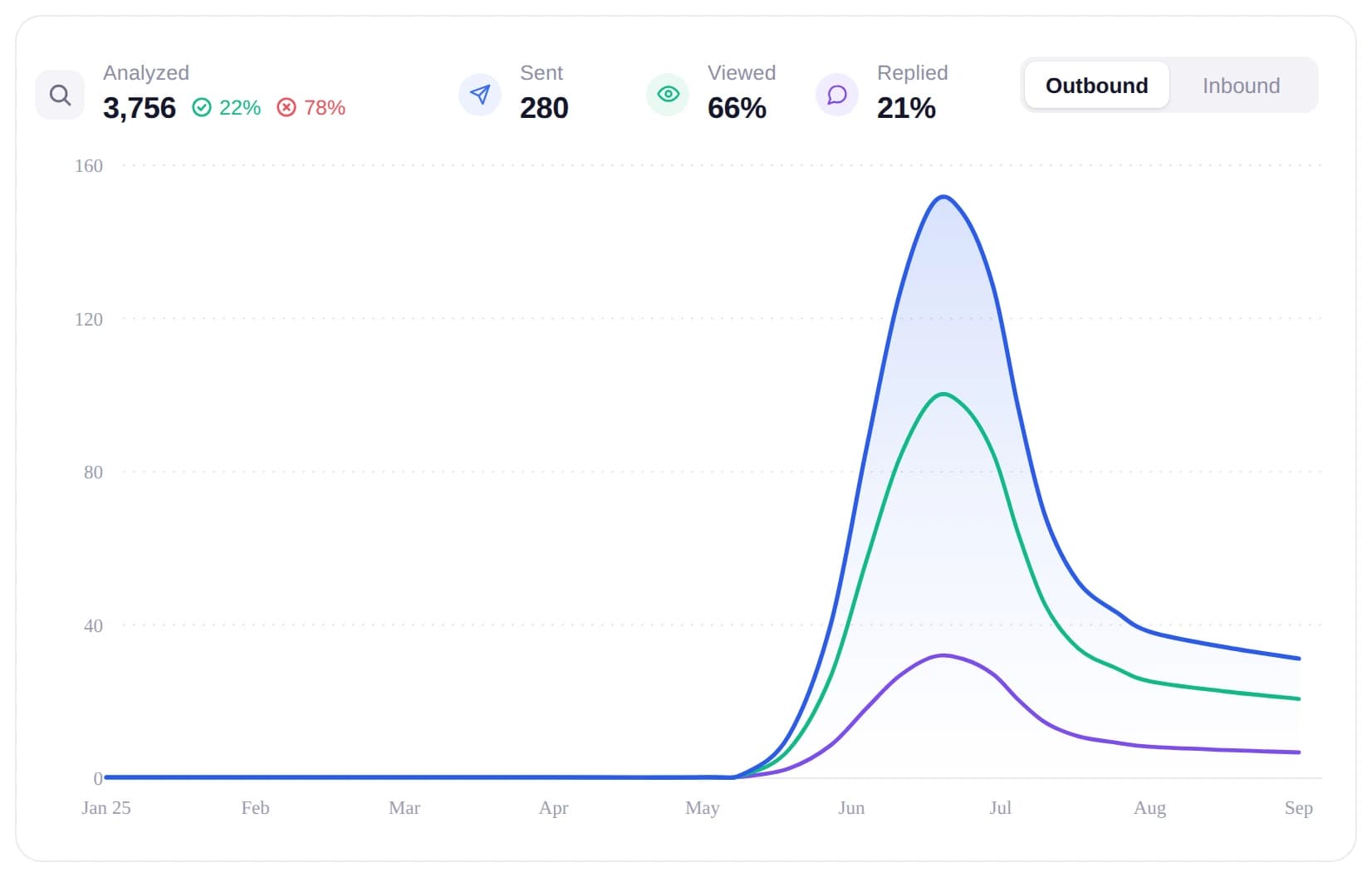
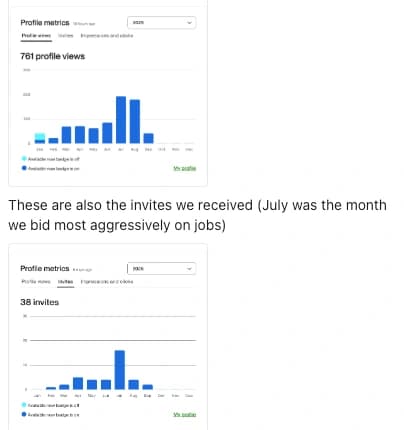
Across 2025 that came to 761 profile views and 38 job invitations, and his invitations ran roughly 4X higher once he was sending consistently than during the stretch when he was not. The mechanism is not mysterious: Upwork surfaces freelancers who are visibly active, because an active freelancer is one who will actually answer. Proposals buy you views, views buy you invitations, and the invitations cost nothing.
Which is the argument for the freelancers who think none of this applies to them — the ones with enough inbound that they stopped bidding years ago. Nikola was one of them. He went almost two years without a single invite during the period he was not applying, because inbound does not hold steady when you stop; it decays. If you are not at full capacity, the cheapest leads available to you are the invitations you unlock by sending proposals you were not planning to send.
The way I see proposals is almost as paid ads. You spend a few bucks to be seen by the right eyeballs.
Nikola — Webflow Expert — Co-founder, Flowscape
🤓 Upwork Pro Tip
If you are not at maximum delivery capacity, keep sending proposals even when inbound is healthy. The proposals are marketing for your profile: Upwork rewards visible activity with more profile views, more invitations and more direct messages — the leads you did not pay Connects for.
The case for Upwork in 2026
Upwork is better now than when he joined in 2019, Nikola argues — you just have to be more strategic. His argument is deal size and fairness. When he started, the best people in his niche topped out around $5K–$6K per project; today he holds contracts over $100K on the platform. Connects stop everyone from mass-applying to everything, and invitations are no longer reserved for accounts that already have badges — apply regularly and the algorithm starts rewarding you.
On the 10% fee that dominates every Upwork complaint thread: Stripe alone takes around 3% to process a payment, and Upwork bundles escrow, contracts and a public earnings record on top of that. Nikola still shows prospects his Upwork profile when he pitches them off-platform, because verified public earnings and 113 completed jobs of public feedback are the strongest trust signal he owns.
Compared head to head, the channels are not close. Upwork brings Flowscape at least four clients in a month; LinkedIn brings roughly one client every four months, at a higher cost and with a far longer sales cycle. Around 80% of the agency’s clients now come from Upwork. He tried Contra and found the client pool too small, tried Fiverr and disliked being at the mercy of discovery instead of being able to apply, and passed on Toptal after being accepted because he was already charging more on Upwork than Toptal wanted to place him at.
Drop the ego for the first few contracts
Give it two to three months before you judge it, and do not optimise for money first. Build the profile, build the portfolio, collect a few genuinely good reviews, and accept that the early jobs will pay badly — the $15 project is the price of the social proof that lets you go after the bigger fish later. Drop the ego for the first few contracts.
On cover letters, which he rates as very important: the first sentence does almost all of the work. Nikola treats it like the hook on a LinkedIn post, because in his niche a job can carry 70 to 80 proposals and the only thing standing between him and the other 79 is whether the client opens his. Length and word choice matter far less at the start than knowing who your ICP actually is — his own cover letter has improved year over year purely because he understands his clients better, and he still treats it as a work in progress.
Give it two to three months. Apply to jobs, spend some money on Connects, focus on delivering for those clients. You will see returns — I can almost guarantee that to everyone.
Nikola — Webflow Expert — Co-founder, Flowscape
What he says when we are not in the room
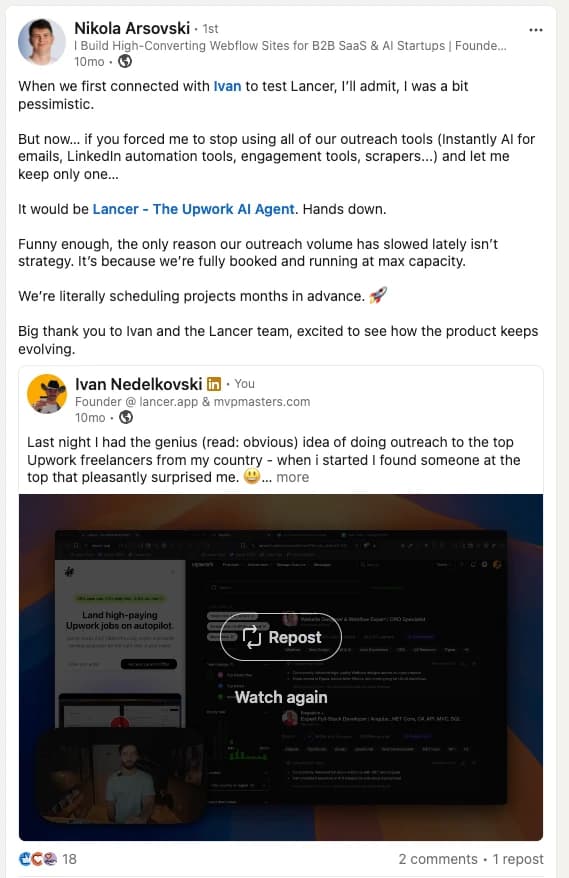
None of the above is something he only says on a podcast we produced. Nikola runs a full outbound stack — Instantly for email, LinkedIn automation, engagement tools, scrapers — and he posted publicly about which one he would keep if he had to drop the rest.
If you forced me to stop using all of our outreach tools and let me keep only one, it would be Lancer. Hands down.
Nikola — Webflow Expert — Co-founder, Flowscape
Full transcript — Lancer Case Study Ep. 2: Nikola
Auto-transcribed and lightly edited. Timestamps link into the video. Download it to feed into Claude Code or any other AI agent.
Show full transcriptHide full transcript
00:00Introduction
Ivan: This episode is a bit different from the previous one — a bit longer, more of a mini podcast, and I am joined by Nikola. Nikola is a dear friend of mine. He is also from Macedonia, so we had the privilege of recording this interview here in my studio.
Ivan: He is one of our earliest users. He beta tested Lancer for us and helped validate the product itself, and he has been with us since the beginning. We will not talk that much about how he uses Lancer, and this is not really an advertisement for Lancer. The focus is his actual storyline: how he started at 20 years old, part-time freelancing on Upwork for $15 and $50 projects, and scaled that to a full agency working with enterprise clients on six-figure deals — all through Upwork.
Ivan: Because this is a longer episode, there are chapters below so you can skip to whatever is most relevant to you.
01:37Nikola's first Upwork client and the offer he was running then
Ivan: Do you remember your first Upwork client, your first online payment? What was that experience like?
Nikola: I do. I was applying to every job. I was positioning myself almost as an expert even though I was not an expert, and my pitch was: I am an expert trying to build out a portfolio on Upwork, so I will do it for a cheaper rate.
Ivan: So even back then that worked. That is also what I did when I started.
Nikola: Pretty much. I had a $15 project that I worked on for two weeks. Flat, not hourly. And I was so excited to work on it — I remember it was New Year’s Eve and I went to bed early to wake up in the morning and continue working on the project. My birthday is the 3rd of January, so I worked through my birthday and everything. I was so excited to make my first money online.
02:47Nikola's earnings breakdown: from $15 jobs to six-figure contracts
Ivan: I wanted to pull up the profile here to drive this point further. This is Nikola’s profile: hundreds of thousands of dollars earned, hundreds of jobs closed, six-figure jobs. But if you scroll all the way down — this is all public data — you go back six years and you find a $25 job, a $50 job, a $60 job, a $40 job. Then a $600 job, then back down to $150, $380, $800, $200. The average is going up, but he was not afraid to pick up those jobs while he was building his profile.
Ivan: Now filter by largest projects. Three years later — that is not a long time — he has a six-figure job with an Upwork enterprise client, a $30,000 job, five-figure jobs, four-figure jobs. You start at $40 and then you have six-figure projects.
Ivan: The gap between those jobs is where people get frustrated and quit. The ego works against them: why would I work with this guy for $50 or $100? They cannot see that they are building up their Upwork profile. This is your digital storefront. You are building legitimacy at the beginning — you are not making profit at the beginning, like in any career. Think of it as someone paying you to learn on the job. And once you are a legitimate specialist five years down the line with all of that proof behind you — hundreds of jobs, 100% Job Success, Top Rated Plus, hundreds of thousands of dollars earned — then you get the enterprise client and the six-figure deals.
07:13Dropping out & going full-time on Upwork
Ivan: When did you transition Upwork into an actual channel where you make money and it becomes stable income?
Nikola: The way I looked at it, freelancing might work, might not, but at the end of the day I would build out a design portfolio. My actual plan was to start applying for jobs and get my first design role. But I got one client, then a second client — the second one was around $40 flat. Then I had a four- or five-hour hourly contract that made me around $70. And that just scaled and scaled, until I got to a point where I was making $400 or $500 a month.
Ivan: How old were you back then?
Nikola: I think I was 20.
Ivan: In Macedonia that is almost above the average salary. And it was not full time?
Nikola: It was not full time. I was still a student — this was on the side of doing college, so really not related. Then I remember the first time I hit $1K per month. That was the moment of: okay, you can make some serious money here. All pure Upwork, 100% Upwork.
Nikola: After a couple of months of making $1K I was at a crossroads: continue college, or drop out and go into freelancing. I calculated what my salary would be when I finished college, and I was already making almost double that. I was not passionate about what I was studying, so it did not make sense to continue. I dropped out and focused on freelancing and on building out my skill sets — more than on having high rates. I wanted a solid base, and I was more excited to learn and grow than to focus on the money.
08:18Hot take: Upwork now is better than ever, and here is why
Ivan: So you have been on Upwork since around 2019?
Nikola: December 2019, yes.
Ivan: Everyone says Upwork is not what it was. Can you compare Upwork then and now, and make the argument for each?
Nikola: I would say Upwork is better now. You have to be more strategic about it — before, the start was a bit easier — but once you get the ball rolling, Upwork today is a better platform.
Nikola: A few reasons. More serious clients come to Upwork now; there are a lot of enterprise clients. New jobs pop up every day and a lot of people are finding opportunities in those new roles. And the deal sizes are different. Back then, when I looked at the top people in my niche, the biggest project most of them had was $5K to $6K. Right now I have contracts over $100K on the platform.
Nikola: The other advantage is fairness. Yes, the competition is larger, but Connects mean people are not massively applying to everything — that part is regulated. Back then, if you were not Top Rated or top in your niche, you could forget about invites. Now it is a much more even playing field. Even if you create an Upwork profile today, if you apply to jobs regularly you will start to get invites — the algorithm will reward you. Overall the platform is a lot more built out and polished.
10:26What r/Upwork gets wrong, and why Upwork is the best platform for freelancers and agency owners doing under $100K/month
Ivan: So why do you think there is a whole separate group on Upwork that is constantly complaining? What are they missing?
Nikola: Let us ask them where they get their clients from instead. Running your own business is not easy, there are challenges. But the main argument people use against Upwork is the 10% fee, plus low-quality jobs. There are always going to be low-quality jobs — it is hard to get a good-quality job. If it were easy, everyone would get it.
Nikola: On the fee: break it down against other platforms. Stripe alone has a ~3% processing fee. With Upwork you get an escrow service, so you are guaranteed to get paid for your work. Contracts are handled for you. And you build a reputation you can then use on other channels.
Ivan: Public earnings, public reviews. You are a Webflow expert, Top Rated Plus, hundreds of thousands of dollars earned on Upwork, hundreds of positive reviews. I have seen a lot of agencies and freelancers put that on their own website — that they are a Top Rated Plus expert. That is one of the advantages of building Upwork as a channel.
Nikola: Exactly. When I reach out to clients I show them my website, but I also show them my Upwork profile, because that is the biggest trust builder I have. I do not have a big audience on other platforms, so when I reach out I leverage what I have on Upwork, and it helps a lot.
12:33Upwork (4 clients in 1 month) VS LinkedIn (1 client in 4 months)
Ivan: Can you break down the acquisition channels you use right now, and how Upwork compares to the others?
Nikola: Right now Upwork is our main channel for client acquisition. We also built partnerships with a few other agencies, as a subcontractor — but the problem there is lower rates, inconsistent work, and getting the work they do not want to do. You always get the toughest clients that pay the least.
Nikola: The other one is LinkedIn. LinkedIn is a pretty good channel, but the process of getting a client there is a lot more expensive and a lot more time-consuming. You have to warm people up and almost hunt them down. I just got a client on LinkedIn that I had been chasing for seven months, giving them suggestions on how they could improve. The way she eventually responded was: okay, you have been hunting me for seven months, our Webflow agency is not working out, let us schedule an interview. It is a much longer sales cycle, which is not ideal for a turnaround service like Webflow — most of our clients just need a website, and once the website ships, that is pretty much it.
Ivan: You mentioned a number that stuck with me: on Upwork it is at least four clients a month, and on LinkedIn it is one client in four months. That is almost 16 times the client volume.
Nikola: That is correct. About 80% of our clients currently come from Upwork. We are closing down the agency-partnership channel because the math does not work well enough for us to scale it. So Upwork and LinkedIn are our main acquisition channels going forward.
15:17Breakdown of achieved ROI on Upwork spend in a given month: 15x ROI analysis
Ivan: I am going through some of the numbers you shared with me for July. This is insane ROI. You spent around $400 in Connects, and $6.6K was paid out on Upwork from that deal flow. That is roughly 15X on money actually collected inside the month. I do not see any other platform where you can just plug in, spend this much and get this much without extra effort — especially since you solved the friction of scaling proposal sending with Lancer.
15:49The most stressful thing about Upwork
Ivan: We have talked about all the good things. What are the worst parts? What is the hardest thing about the channel?
Nikola: The hardest thing is being under constant stress of performance, because you have to perform well for clients to leave you good reviews and for you to keep growing. It is not like other channels. You always have to be good at what you do, and do it consistently over years.
Nikola: Which is also a plus — you build skills, you build skills in managing people, and you need bulletproof processes. But the biggest negative is that you are at the mercy of the people you work with. You have to be selective about who you choose to work with, to make sure they do not turn out to be crazy and leave you a bad review for basically nothing.
16:55Nikola's Upwork strategy: where does he spend Connects, and what works best for him
Ivan: Everything on Upwork is monetised now — Available Now badges, boosting your profile, boosting proposals, tools and strategies. How do you break down where and how you spend Connects? How do you approach discovering jobs and sending proposals? What do your invitation numbers look like?
Nikola: I approach it with testing, like everything else. When the Boost Profile feature came out, I boosted my profile — I did not see a huge ROI in that. When boosted Connects came out I started using those, and experimented month to month, using it and not using it. At this stage, we boost every proposal we send out. The way I see proposals is almost as paid ads: you spend a few bucks to be seen by the right eyeballs. That is how the majority of other channels work too.
Nikola: On invitations — that was a big part for me. Because we had so much client volume, for about a year and a half I did not apply to a single Upwork job. Now that we are scaling, with three team members on board plus my co-founder, I have gotten back into the habit of applying to jobs regularly. What I noticed is that the more you apply, the more the algorithm rewards and boosts you, and the more invites you get.
Nikola: For reference: I did not get an invite for a year and a half, almost two years, while I was not applying. When I started applying again I still did not get invites for the first few months. But once I started applying regularly, pretty much daily, I now get at least three official Upwork invites a week. I also get a lot of DMs on Upwork — people who do not even post a job, they just message you asking if you are interested, or to schedule a call. So: two to three official invites, plus one or two of those messages per week.
19:48Organic inbound is increased by sending proposals
Ivan: On this topic — increasing the number of inbound organic leads you get on Upwork for free whenever you increase the volume of proposals you send — we have concrete data to back it up. Nikola shared his stats with us, and if you overlay them with his Lancer dashboard you see a clear parallel between the number of proposals he sent and the profile views and invitations he got in the same period.
Ivan: This chart runs from May to September. May into June is increasing, then July hits a peak — that was his biggest month yet. Then in August he was at full capacity, so he lowered the number of proposals sent. And that had a direct correlation with the extra inbound leads he got. His profile is not boosted — this is completely organic. In July, when he sent the most proposals, he had the most profile views, which also produced the most invitations. In August the proposals came down and the invitations came down with them.
Ivan: A lot of people say they rely only on invitations and inbound and never send proposals. Even then: if you are looking to scale and you are not at max capacity, you should be sending proposals, because the Upwork algorithm will give you even more invitations.
22:06Nikola's advice to people starting on Upwork today
Ivan: What is your biggest advice for someone looking to start this journey right now, going into freelancing or an agency as a service provider?
Nikola: Pick a platform. I am biased towards Upwork, so I would recommend Upwork. Do not focus on the money straight away. Focus first on building out your profile and your portfolio, and getting a few good reviews. After that you have the social proof to hunt bigger clients and go for the bigger fish.
Nikola: After a couple of months of doing that, if you stick to it, you will see the rewards coming in. And once you see them, there is no looking back — you just look to scale and go forward. So put your head down for the first few jobs. Drop your ego. You might have to work for lower rates. But if you do a good job, the rewards are not comparable to what you gave up in those few months. This is a long journey — focus on the long-term vision and do not get set back by short-term outcomes.
Ivan: So you think anyone who is genuinely a great service provider, with the time, resources and conviction, can start even today on Upwork and establish it as their biggest acquisition channel?
Nikola: Pretty much. Give it two to three months. Really give it two to three months: apply to jobs, maybe spend some money on Connects, focus on delivering for those clients and making them happy. You will see returns. I can almost guarantee that to everyone.
24:04How important are cover letters, and how to write a winning cover letter in 2026
Ivan: We did not touch on positioning yourself with an offer. How much did you think about the offer inside the cover letter, and how you write it? I have seen users write a whole essay, and others send one or two paragraphs — and depending on the niche and the client, both can work. What is your strategy, and how important do you think the cover letter is?
Nikola: It is very important. It is the first touch point, the first impression you leave. Focus on the first sentence — the first thing that appears for them. I joke that you have to think about it like a LinkedIn post: you have to hook them with the first sentence, make it interesting enough to stand out, so that they open your cover letter at all.
Nikola: My niche is very competitive — there are jobs with 70 or 80 proposals. Out of 70 or 80 people, you need a strategy to stand out. That could be your first sentence, your profile photo, your overall profile. There are a lot of free resources online on how to do that and how to test it.
Nikola: On the length and the word choices, I would not focus on it too much at the start. Once you have experience working with clients and you have built out an ICP — who your clients actually are — you understand them a lot better and you understand how to communicate with them. My cover letter has gotten better and better as the years passed, as I understood who my clients are, how I can help them, and how to present my value to them. It is a work in progress.
Ivan: So it is constant improvement. Not something you do once and forget — you test it and iterate, because depending on the niche and your clients, different people have different needs and wants.
27:30Upwork versus Contra, Fiverr, and Toptal
Ivan: Have you tried other platforms, and how do they compare?
Nikola: I tried Contra, which is a newer platform specifically for the design niche. To be honest I did not have much success there — maybe partly because I did not give it my all. But the main thing is that Upwork is so concentrated with clients. It is the biggest freelancing platform out there, and from a big pool of clients I believe that is the best strategy. Contra is a great platform, but it is very small.
Nikola: Fiverr is obviously the biggest competitor. I tried Fiverr, but the way I understand it, Fiverr is more about luck: people have to discover you, and you cannot be proactive about finding jobs, which I think is a big negative. You are at the mercy of the algorithm. On Upwork, even if the algorithm does not favour you, you always have the chance to apply and get a level playing field. On Fiverr, if someone has a long history you cannot compete with them — you have to cut your prices, and where on Upwork that takes a month, on Fiverr you are cutting prices for years to build up those reviews.
Nikola: I also gave Toptal a shot. I went through the whole interview process and I was accepted, but I ultimately did not want to go on the platform, because when we talked about my hourly rate I was already charging more than that on Upwork. It did not make sense to join a platform that brands itself as premium when I already charge more elsewhere — and on Upwork I can scale as an agency rather than being limited to being a freelancer.
29:57Closing thoughts and advice from Nikola
Ivan: Thank you, Nikola. This was very informative. If anyone has questions, leave them under the video and we will answer them. Anything else to add?
Nikola: I would just encourage everyone who wants to start on Upwork to give it a shot and actually start. Do not be afraid. Do not focus too much on the negatives people associate with Upwork. Just give it a shot — you will see how rewarding it is. And if anyone has questions about Upwork or freelancing, feel free to contact me. I am more than open to giving out suggestions.
Keep crushing it, Nikola ❤️
Ready to run Upwork like Nikola does?
Book a demo and we’ll show you how Lancer turns Upwork into a predictable client channel — boosted proposals, sent through your own account, with the numbers to prove what a month buys you.